Autonomous Checkout in 2026: What’s Actually Live in Stores Today
August 6, 2026 | by Siva Prakash
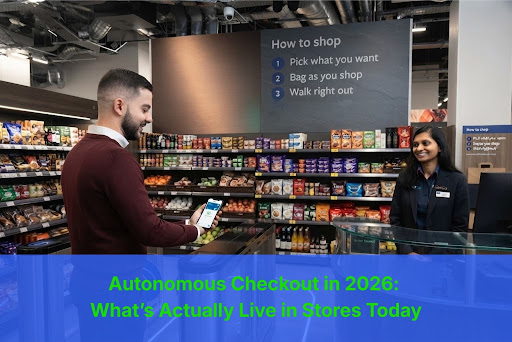
A customer walks into a small convenience store in a student residence late at night. There is no cashier. No queue. There is no cash desk. No need to wait until morning. They scan what they need, pay on their phone, receive a digital receipt, and leave. Behind the scenes, the transaction updates the retailer’s systems, stock data is synchronized, and the store keeps trading without an employee on site. That is not a future concept. That is autonomous checkout as it exists in 2026.
Not as a hardware-heavy flagship experiment. Not as a full supermarket trying to remove every checkout lane overnight. But as a practical operating model for high-footfall, convenience-led retail environments where 24/7 access, lower operating cost and faster checkout create a clear commercial case. This is the version of autonomous checkout that matters now.
The market has moved beyond asking whether checkout can be automated. It can. The harder question is where automation improves store economics.
Autonomous Checkout Is No Longer One Thing
For years, autonomous checkout was discussed as if it meant one specific experience: customers walk in, pick up products, and leave while the store automatically detects what they bought. That model still exists, but it is only one part of the category.
In 2026, autonomous checkout includes several practical formats:
- Mobile Scan & Go
- Self-checkout
- Cashless unattended stores
- QR-code-based store access
- App-based payment and digital receipts
- Hybrid checkout models
- 24/7 micro-convenience stores
- ERP-connected autonomous retail environments
The winning model depends on the store.
A full grocery store, a student accommodation convenience store, a hospital micro-market and a hostel pantry do not have the same checkout problem. They have different basket sizes, product ranges, staffing models, shrink risks and customer expectations. That is why the most successful autonomous checkout deployments today are not trying to force one technology into every retail format. They are matching the checkout journey to the operational reality of the store.
What’s Actually Live in Stores Today
Autonomous checkout is live today in the places where the customer mission is simple and the business case is obvious. It is live in convenience-led locations where customers usually buy a few items and want to leave quickly. It is live in student accommodation and hostels where demand often continues outside normally staffed retail hours. Autonomous checkout is live in workplaces, campuses, hospitals, residential buildings and compact stores where traditional labor models can make retail commercially difficult.
What these locations have in common is not the technology itself. It is the economics. The store needs to trade for longer hours than staffing would normally allow. The basket is typically small. The product range can be controlled. The customer values speed and access. And the retailer needs a model that does not depend on placing staff in every location at every hour of the day.
That is where autonomous checkout becomes more than a customer experience upgrade. It becomes a way to open stores that might not otherwise be viable.
Why Full Walk-Out Retail Hasn’t Become the Default
The reason autonomous checkout has not replaced every checkout lane is simple: retail is operationally complex.
A large grocery store has weighted produce, fresh items, age-restricted products, promotions, loyalty pricing, refunds, substitutions, exceptions and high SKU complexity. Every one of those areas creates friction if the checkout system is not deeply connected to the rest of the store.
That is why many retailers have become more pragmatic. They are no longer asking, “How do we remove checkout completely?” They are asking, “How do we remove the right amount of friction without adding operational complexity?”
For many formats, the answer is not a fully invisible checkout. It is mobile Scan & Go, self-checkout, cashless payment, access control and backend synchronization working together in one flow. That may sound less futuristic, but it is often far more deployable. And in retail, deployable matters.
Why Self-Checkout Alone Is Not Enough
Self-checkout has become familiar, but self-checkout alone does not make a store autonomous.
In many stores, self-checkout simply moves the scanning task from the cashier to the customer. If the kiosk is disconnected from inventory, promotions, payments, receipts, and reporting, the retailer has not really automated the store. It has only moved the friction.
The problems show up quickly.
A product does not scan. A promotion does not apply. A receipt does not match. Stock data is delayed. Staff still have to intervene repeatedly. The customer feels the issue at the front end, but the root cause usually sits in the backend. Autonomous checkout only works when the full journey is connected.
That means product data, payment, receipts, inventory, store access, reporting and exception handling all need to operate as one system.
What a Practical Autonomous Checkout Model Needs
A working autonomous checkout model in 2026 needs more than a payment screen. It needs a complete operating flow. Customers need to enter securely, shop easily, scan or select products, pay without friction, receive a compliant receipt and leave without confusion.
Retailers need sales and inventory data to sync reliably. Payments must reconcile cleanly. Receipts must meet local requirements. Non-barcoded items need a clear workflow. Access control must be secure. Emergency exit must be handled properly. Shrinkage and fraud controls need to be built into the model.
This is the difference between an autonomous checkout concept and an autonomous retail operation. One looks impressive in a pilot. The other can trade every day.
Ven Go: Autonomous Checkout Live in Spain
Ven Go Stores is a strong example of practical autonomous checkout in 2026. It has built a fully automated, 24/7 convenience retail model in Spain, designed for high-traffic youth hostels and student accommodation. The stores are cashless, employee-free, and built around mobile-first checkout.

Working with MishiPay, Ven Go moved from a 4-store pilot in Madrid to a strategic 64-store rollout roadmap, supported by a 5-year contract term. Behind that simple journey is the operational architecture that makes the model work.
Ven Go’s stores are managed through Odoo ERP, with API-driven synchronization approximately every 30 minutes to maintain sales and inventory data. Store entry and exit are secured through QR-code-based access control, with safety overrides for emergency egress. The model is designed around real retail conditions, not theoretical ones. Around 98% of stock is barcoded, while the remaining 2% is handled through custom non-barcoded menus. The customer app is white labelled for iOS and Android, localized in English and Spanish, and supports dynamic language switching based on the shopper’s device settings.
That level of operational detail is what makes autonomous checkout scalable.
What the Ven Go Deployment Proves
The Ven Go rollout answers some of the most important questions retailers ask about autonomous checkout. First, it shows that autonomous retail does not need to start with heavy infrastructure cost. The model uses MishiPay’s mobile Scan & Go and self-checkout capabilities rather than requiring a full store rebuild around expensive hardware.

Second, it lowers operating cost. Because the stores are designed to run cashless and employee-free, Ven Go can serve locations where traditional staffing would be difficult or commercially inefficient. Third, it proves that speed to market matters. The deployment went live in two weeks, allowing Ven Go to move quickly from pilot to rollout planning without waiting through a long transformation cycle.
Fourth, it unlocks 24-hour trading. In student and hostel environments, demand does not stop when a staffed store would normally close. A 24/7 autonomous model means fewer missed sales and more availability for customers. That is the real value of autonomous checkout in 2026. Not just faster payment. Better store economics.
The Real Opportunity for Retailers
The strongest autonomous checkout opportunities today are not necessarily in replacing existing checkout lanes. They are in enabling new formats. A compact convenience store inside a student residence. A self-service pantry in a residential building. A 24/7 essentials store in a hostel. A micro-market in a workplace. A small retail point inside a hospital or campus.
These locations often have customer demand, but not enough volume to justify a traditional staffed model. Autonomous checkout changes that calculation. If the store can run with lower capex, lower opex and minimal on-site labour, more locations become commercially viable. That is why the next phase of autonomous checkout will be less about futuristic concept stores and more about practical retail expansion.
Autonomous Checkout in 2026 Is About Execution
The autonomous checkout conversation has matured. Retailers no longer need another prediction about the future of shopping. They need checkout models that can go live quickly, integrate with existing systems, reduce operating friction and scale beyond a pilot.
That is where MishiPay fits. MishiPay enables mobile Scan & Go, self-checkout and cashless payment journeys through a flexible platform that supports real retail operations. For autonomous and unattended stores, that means the checkout experience can connect with access control, ERP synchronization, digital receipts, fiscalization and operational reporting.
The result is not technology for its own sake.
It is a checkout model that helps stores trade longer, operate leaner and open in places where traditional retail economics do not work. Autonomous checkout in 2026 is not about removing every cashier from every store. It is about giving retailers the flexibility to match the checkout experience to the store format, the customer mission and the commercial reality of each location.
That is what is actually live in stores today. And it is where autonomous checkout becomes commercially real.