Grocery Checkout in 2026: What Shoppers Actually Expect Now
April 22, 2026 | by Siva Prakash
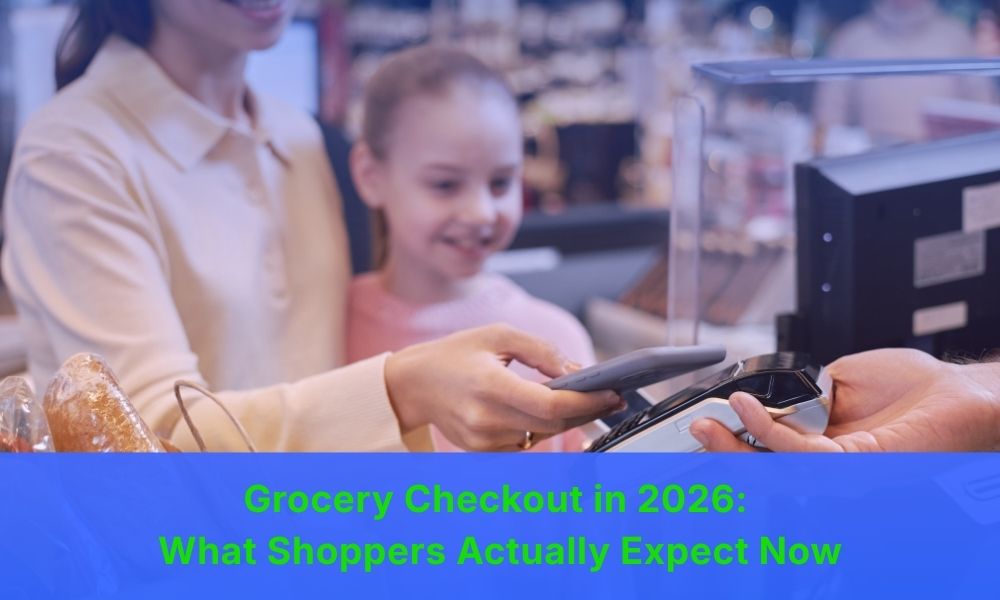
There’s a moment that matters more than most grocery operators realise. It’s not when a shopper picks up a product. It’s not when they decide to stay or switch stores. It’s the thirty seconds at the checkout, the final impression that determines whether they leave feeling the trip was worth it or already considering somewhere else next week.
In 2026, that moment is under more pressure than at any point in the history of grocery retail. Shopper expectations have shifted, shaped by digital experiences, accelerated by economic pressure, and increasingly influenced by the best checkout experience they’ve had anywhere, not just in grocery. Understanding what those expectations actually look like, based on current research rather than assumptions, is one of the most commercially useful things a grocery operator can do right now.
Speed remains the primary driver, but the definition has changed
Speed has always been central to grocery checkout. In 2026, it is the defining factor.
NCR Voyix’s 2025 Commerce Experience Report, which surveyed 1,044 US consumers, found that 77% of shoppers who prefer self-checkout say they do so specifically because it’s faster than staffed checkout. Speed is not a preference. It is the primary reason shoppers actively choose one checkout format over another.
What’s changed is what “fast enough” means. Shoppers who have experienced scan-and-go, where they scan as they shop and walk out, now hold that as their reference point. Any format that falls short of it is noticed. And the bar moves in one direction.
But there is a critical nuance in the data. 60% of shoppers who currently avoid self-checkout said they would be more inclined to use it if stores made it easier to check out with more than 15 items, pointing to a design and software problem, not a preference problem. Shoppers want speed. But they want speed that works.
Self-checkout demand is growing, particularly among the shoppers who spend the most
The narrative that shoppers are rejecting self-checkout is not supported by the research.
NCR Voyix’s 2025 data shows that 63% of Gen Z shoppers (ages 18-29) actively prefer self-checkout, as do 45% of Millennial shoppers (ages 30-44). These two cohorts represent the fastest-growing share of grocery spending. Their preference for autonomous, technology-enabled checkout is not a niche behaviour. It is the direction of travel.
The retailers who pulled back on self-checkout in 2024 and 2025 were not responding to a preference shift. They were responding to operational failures: software that couldn’t handle produce weighing, age verification that required physical staff intervention at every kiosk, and promotional rules that didn’t sync correctly across systems. The checkout format was not the problem. The infrastructure underneath it was.
RBR Data Services forecasts that self-checkout terminal installations could reach 2 million globally by 2029. The shopper’s appetite is real and growing. What operators need is self-checkout that works reliably, at a grocery-specific scale.
Loyalty is expected to work, not just to exist
Grocery leads every other retail category in loyalty programme adoption. NCR Voyix’s 2025 research found that 70% of shoppers are members of at least one grocery loyalty programme, higher than fuel convenience (54%) or restaurants (51%). And 75% of those members receive personalised offers daily or weekly.
Those are strong numbers. But PwC’s 2025 Customer Experience Survey, which surveyed more than 5,500 US consumers and 400 executives, reveals the gap between enrolment and perceived value. Nine out of ten executives say customer loyalty has grown in recent years. Only four out of ten consumers say the same. 57% of executives admitted their loyalty programmes aren’t delivering the expected results. And 52% of consumers say they stopped using or buying from a brand because of a bad experience.
What this tells grocery operators specifically: loyalty programmes are widely adopted, but loyalty itself is fragile. And one of the fastest ways to erode it is a checkout experience where the loyalty mechanic fails, a promotion that doesn’t apply, a member discount that doesn’t recognise the account, or a points balance that doesn’t update. PwC’s research also found that 68% of consumers said exclusive rewards could make them loyal, and 59% cited personalised experiences or offers. Shoppers want loyalty to feel personal and functional, not just enrollable.
Value consciousness is reshaping the role of promotions at checkout
The economic context of 2025-2026 has made promotions more operationally important than they have ever been.
Ibotta’s 2026 State of Spend report, based on a survey of 5,048 US grocery shoppers conducted in November 2025, found that 62% of shoppers now say price matters more than brand name. Nearly one third (32%) now shop with only a loose idea or no plan at all, making in-store promotional mechanics more influential on the final basket than pre-trip list-making.
NielsenIQ’s 2026 Consumer Outlook, based on nearly 19,000 consumers across 27 countries, describes seamless commerce as the next frontier, noting that faster checkouts and personalised offers are among the key factors that signal to shoppers that a brand should be trusted.
The operational implication is significant. When more shoppers are making purchasing decisions in-store rather than in advance, the checkout is no longer just the point of payment. It is the last opportunity to deliver on a promotional promise, and the most visible place where that promise can fail. When a basket-level promotion doesn’t fire at the kiosk because the system isn’t synced to current pricing rules, the shopper notices. And in a market where 62% of shoppers are already prioritising price over brand, a missed promotion is not a minor inconvenience. It is a reason to reconsider.
Personalisation is moving from the app to the checkout
Personalisation in grocery has historically lived in the marketing layer: email campaigns, app notifications, digital coupons. In 2026, shopper expectations are beginning to extend to the in-store moment itself, including checkout.
PwC’s 2025 Customer Experience Survey found that 59% of consumers said personalised experiences or offers would make them more loyal to a brand. NielsenIQ’s research emphasises that personalised offers at the right moment are increasingly central to what shoppers understand as good service, not a bonus, but an expectation that is quietly forming.
This doesn’t require an AI-powered kiosk at every lane. It requires a checkout platform connected to data that already exists, purchase history, loyalty membership, current promotions, and capable of surfacing it at the point of transaction. Deloitte’s 2026 Retail Industry Outlook, which surveyed 330 retail executives with 86% from retailers with annual revenues of at least $1 billion, found that delivering on personalisation and frictionless checkout were among the highest priorities for enterprise retailers entering 2026. The gap between what operators know shoppers want and what the checkout environment actually delivers is the commercial problem of this moment.
The in-store channel is still dominant, which makes checkout more critical, not less
Amid years of attention to e-commerce, the in-store grocery experience remains the dominant channel by a considerable margin.
NielsenIQ’s Omnishopper data shows that in-store purchases still account for approximately 77% of FMCG sales in the US, with household spend per year in-store ($8,222) remaining almost three times higher than online ($2,737). PwC’s 2025 Voice of the Consumer Survey, which surveyed 21,075 consumers across 28 countries, found that in-store visits to supermarkets continue to dominate, making up 62% of the daily or weekly food shop, even as the average consumer now accesses approximately 3.6 food shopping channels.
The growth of multi-channel shopping does not diminish the importance of in-store checkout. It intensifies it. Shoppers who have a poor checkout experience in-store now have a wider set of alternatives to consider next time. The in-store checkout is competing against the frictionless experience of a tap-to-pay online order and the speed of a well-implemented scan-and-go format. The stakes for getting it right have never been higher.
What this means for operators in 2026
The expectations described above are not emerging trends. They are current realities that a growing share of grocery shoppers already hold. Three things follow for operators thinking seriously about checkout in 2026.
Speed and reliability are the floor, not the ceiling. A checkout that works correctly and quickly meets the minimum expectation. Differentiation comes from consistency, ensuring that the experience at the self-checkout kiosk matches the staffed lane, that promotions fire correctly across every touchpoint, and that loyalty is recognised without the shopper having to think about it.
The loyalty and promotions mechanic is where value is being lost right now. PwC’s research shows the gap between executive confidence in loyalty programmes and consumer perception of them is wide and widening. The most common point of failure is at the checkout, where a promised benefit doesn’t materialise, eroding the entire programme’s credibility in a single transaction.
The checkout is a data moment as much as a transaction moment. Shoppers in 2026 are beginning to expect that what the store knows about them shows up at the point of sale. Operators who treat checkout as purely transactional are leaving both revenue and loyalty on the table.
Closing the gap between what shoppers expect and what most checkout environments deliver is not primarily a customer experience initiative. It is a technology infrastructure decision. The checkout experience a shopper has in 2026 is almost entirely a function of whether the systems underneath it were designed to deliver it.
How MishiPay helps grocery retailers close that gap

At MishiPay, we’ve built a complete grocery checkout platform designed around exactly the expectations described above, not as individual features, but as a unified system.
Staffed cash desks, self-checkout kiosks, and scan-and-go mobile checkout all run on a single software foundation. One product catalogue. One promotional engine. One loyalty layer. One back-office integration feeds every touchpoint simultaneously, so promotions fire correctly everywhere, loyalty is recognised automatically, and weighted produce, age verification, and payment flexibility all work as they should, without staff intervention at every other transaction.
For operators thinking about what their checkout infrastructure needs to look like in 2026 and beyond, whether that’s making self-checkout work properly for the first time, unifying fragmented systems, or deploying faster without replacing existing hardware, we’d love to have that conversation.
Get in touch with the MishiPay team. We work with grocery retailers across North America, Europe, and the Middle East.