How MishiPay’s RFID Solution Delivers Sub-20-Second Checkouts at Canada’s Largest Stadium
March 27, 2026 | by Siva Prakash
The stadium retail problem
Stadium merchandise stores face a unique challenge: serving thousands of fans in compressed timeframes while they’re eager to get back to the action on the court or the ice. Peak demand hits just before the game, during halftime or intermissions, and when the home team wins — often right after the final whistle. Traditional barcode checkout creates bottlenecks that result in lost revenue and a diminished fan experience, because every second spent in a queue is a second not spent watching the game.
Fans’ expectations have also been shaped by fast, seamless online checkout experiences. In a stadium environment, that impatience is magnified: if the line looks too long or barely moves, many fans simply walk away rather than risk missing a key moment.
Why RFID?
Radio Frequency Identification (RFID) fundamentally changes retail checkout through three core advantages.
Speed: Modern RFID systems read multiple tags simultaneously, whereas barcode scanning requires each item to be handled and scanned individually. As basket size grows, this gap widens significantly — making RFID particularly powerful in high-volume environments like stadiums.
Accuracy: Because items are detected automatically without line-of-sight, RFID enables far more accurate inventory counts than manual or barcode-based approaches. This reduces missed scans and stock discrepancies that frustrate both fans and operators.
Operational efficiency: Identifying multiple items at once, without physical handling, reduces labour requirements at the checkout and frees staff to focus on helping fans with sizing, product discovery, and jersey selection.
For sports venues, these capabilities translate directly into faster queues, better-stocked shelves, and smoother game-day operations.
MishiPay’s integrated solution at Scotiabank Arena
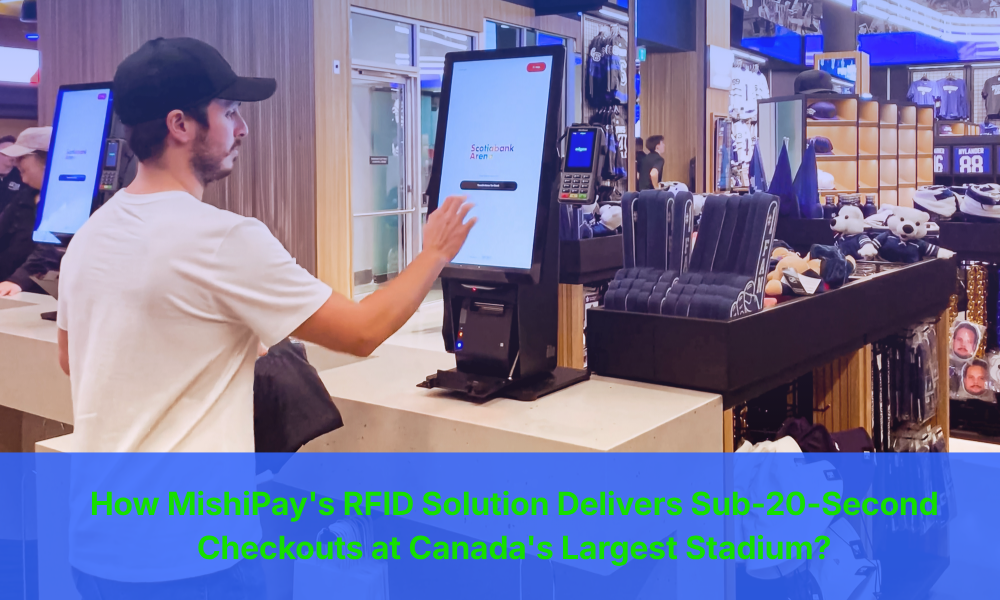
At Scotiabank Arena — home of the Toronto Raptors and Toronto Maple Leafs, and one of Canada’s most iconic venues — MishiPay has deployed RFID-enabled self-checkout kiosks across two flagship Real Sports Apparel stores. These kiosks now serve as the sole checkout solution, replacing traditional manned tills and manual barcode scanning.
The solution combines two critical capabilities:
Fast, intuitive self-checkout: Fans place their items in the RFID scanning zone, where all tags are identified at once, and complete payment on a touchscreen in just a few taps.
Sub-20-second checkout: By eliminating individual item scanning and streamlining payment, average checkout time has been reduced from approximately 90 seconds to around 20 seconds, even at peak times.
Custom jerseys are supported as part of the same experience, allowing fans to select their player and choose a name and number before seeing the final design. While customised jerseys represent a minority of total sales, the kiosks handle both standard and customised items in the same frictionless flow — no separate queue or process required.
This integration addresses the core stadium retail pain point: fans can pick up the merchandise they want, including premium items, without sacrificing time watching the live action.
Business impact for stadium operators
For venue operators like Maple Leaf Sports & Entertainment (MLSE), the impact is both experiential and financial.
Higher transaction throughput: Cutting average checkout time from around 90 seconds to under 20 seconds allows significantly more transactions to be processed during short pre-game and halftime windows.
Labour optimisation: Because kiosks handle item identification and payment, fewer staff are needed on tills. Teams can instead redeploy people to helping fans on the floor, managing queues, and driving upsell opportunities.
Revenue growth: Faster lines reduce abandoned purchases — fans are less likely to walk away — and also encourage impulse buys. Knowing checkout will take seconds makes grabbing that extra scarf or cap an easy decision.
Real-time inventory: RFID tagging across the full assortment enables frequent, highly accurate cycle counts using handheld readers, helping prevent stockouts of popular jerseys and playoff-driven merchandise.
Scotiabank Arena is already seeing these benefits, with MishiPay’s kiosks now the standard way to pay in its busiest team stores.
Technical implementation
Behind the scenes, the deployment at Scotiabank Arena is built on three tightly integrated components.
RFID tags: Every item in the Real Sports Apparel stores is RFID-tagged, with MLSE staff using dedicated printers and scanners to apply tags across the full product range. Each tag links the physical item to its product record in the system, with customisation details associated in the backend where relevant.
Handheld and fixed RFID readers: Handheld RFID readers are used for rapid inventory counts and back-of-house operations, while readers built into the kiosk capture all tags placed in the scanning zone in a single pass. No line-of-sight is required, so items inside a stack or pile are still detected.
Backend integration: MishiPay’s software connects in real time to the arena’s point-of-sale and inventory systems, ensuring that stock levels, pricing, and promotions are always current and that every transaction is recorded accurately.
On the security side, MLSE does not rely on traditional EAS gates at store exits. Instead, security is managed through RFID and system controls: items are marked as sold in the backend once a transaction is complete, and staff focus on monitoring the floor and assisting fans rather than detaching hard tags. This removes another friction point from the checkout journey while still supporting robust loss-prevention processes.
Why stadium environments demand RFID
Stadium retail differs from high-street retail in several important ways that make RFID particularly valuable.
Compressed time windows: Fans shop in short, intense bursts — before the game, during breaks, and right after key moments — creating traffic spikes that conventional checkout simply cannot absorb.
High SKU complexity: A typical stadium store carries a wide range of products across teams, players, sizes, colours, and limited-edition drops, often with customisation options on top.
Premium experience expectations: With ticket prices and production values high, fans expect a similarly elevated retail experience: fast, modern, and hassle-free. Every additional second per transaction means fewer fans served and more lost sales.
Across North America and Europe, leading sports venues are adopting RFID-powered self-checkout as a standard, reporting faster checkouts, higher sales, and more productive retail teams. Scotiabank Arena’s partnership with MishiPay places MLSE among this new generation of operators who see technology not as a cost line, but as a core lever for fan experience.
Conclusion
By rolling out MishiPay’s RFID kiosks in its Real Sports Apparel stores, Scotiabank Arena has positioned itself as a technology leader in fan experience. At a time when stadiums must compete with at-home viewing, a frictionless, sub-20-second checkout experience is a meaningful differentiator that fans notice and remember.
For stadium operators evaluating their merchandise technology stack, the metrics that matter most are transaction speed, throughput during peak periods, and fan satisfaction — and RFID-powered self-checkout delivers measurable improvements across all three.